
In modern industrial automation, non-contact detection plays a fundamental role. Machinery must detect physical objects swiftly without causing mechanical wear. To achieve this seamless tracking, engineers depend heavily on proximity switches. These essential sensors operate without direct target contact, delivering exceptionally long lifespans, fast response times, and high positioning accuracy.
Understanding their working principles helps engineering teams select the optimal sensor for specific automation tasks.

1. Inductive Proximity Switches
Inductive proximity sensors specialize in detecting metallic targets.
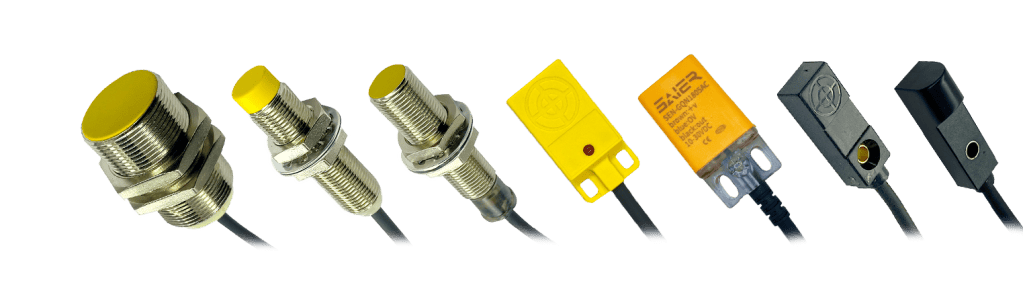
Working Principle: The internal circuit generates an alternating electromagnetic field at the sensing face. When a metallic object enters this field, it induces eddy currents within the target. Consequently, these currents absorb energy from the LC oscillator, causing the vibration amplitude to weaken or collapse completely. The internal trigger circuit detects this change and instantly outputs an ON/OFF switching signal.
Key Characteristics & Applications:
- Target Type: Exclusively detects conductive metals (e.g., iron, stainless steel, aluminum).
- Key Advantages: Highly resistant to ambient oil, dust, and water splashes.
- Typical Uses: Machine tool positioning, automatic punch press control, and metal part counting.
- Recommended Component: Explore our durable Inductive Proximity Switch Series for heavy industrial machinery.
-

M12 प्रॉक्सिमिटी सेंसर इंडक्टिव 2mm सेंसिंग डिस्टेंस DC12-24V
-

औद्योगिक निकटता सेंसर धातु संवेदन M30 निकटता स्विच
-

इंडक्टिव प्रॉक्सिमिटी स्विच IP67 मेटल सेंसिंग डिस्टेंस 4mm
-

SAIER M12 प्रॉक्सिमिटी सेंसर बेलनाकार प्रारंभक प्रॉक्सिमिटी स्विच
-

SAIER M8 बेलनाकार प्रारंभक निकटता सेंसर निकटता स्विच
-

एम18 प्रॉक्सिमिटी सेंसर 12 मिमी डिटेक्शन प्रॉक्सिमिटी स्विच इंडक्टिव
2. Capacitive Proximity Switches
Capacitive sensors provide versatile detection capabilities across both metallic and non-metallic objects.
Working Principle: The sensing surface acts as one plate of an open capacitor, while the surrounding environment or target forms the second plate. As any object approaches the sensor face, the dielectric constant changes, increasing the overall capacitance. This capacitance shift drives an internal oscillator to trigger a clear digital signal.
Key Characteristics & Applications:
- Target Type: Detects liquids, plastics, glass, wood, powder, and metals.
- Key Advantages: Easily penetrates non-metallic container walls to monitor internal liquid or grain levels.
- Typical Uses: Liquid level sensing in plastic tanks, material hopper monitoring, and paper packaging lines.
- Recommended Component: Upgrade your liquid management systems with our high-sensitivity Capacitive Proximity Switch.


3. Photoelectric Proximity Switches
Photoelectric sensors utilize light beams to achieve long-distance object detection.

Working Principle: The sensor emitter projects an infrared or visible light beam toward the target area. When an object passes through, it reflects or breaks the light beam. The receiver detects this light variation and converts the optical signal into an electrical switching output.
Key Characteristics & Applications:
- Target Type: Detects almost all solid objects regardless of material.
- Key Advantages: Offers long sensing ranges from several centimeters up to tens of meters.
- Typical Uses: Automated conveyor lines, automatic doors, smart trash cans, and packaging equipment.
- Recommended Component: Integrate our long-range Photoelectric Safety Sensor for smart automation lines.
-

SAIER फोटोइलेक्ट्रिक स्विच डिस्टेंस सेंसर डिफ्यूजन रिफ्लेक्टिव
-

यू आकार का फोटोइलेक्ट्रिक सेंसर DC10-30V लिमिट सेंसर स्विच
-

अल्ट्रा-पतले डिफ्यूज रिफ्लेक्शन प्रकार के फोटोइलेक्ट्रिक सेंसर
-

Background Suppression Photoelectric Sensor 300mm Distance
-

Beam Photoelectric Sensor M18 Photoelectric Switches SAIER
4. Practical Industrial Applications
Proximity switches serve as the vital sensory organs of modern industrial equipment:
- Automated Elevator Systems: Monitoring floor stopping alignment and door opening safety.
- Smart Medical & Testing Devices: Detecting liquid reagent levels and test tube placement in lab equipment.
- Automatic Door Systems: Triggering sliding doors in public access areas smoothly.
- Packaging and Sorting Machinery: Counting finished bags and verifying filling line capacities.


Conclusion
Selecting the proper proximity switch depends entirely on your target material, detection distance, and environmental conditions. Combining inductive, capacitive, Hall-effect, and photoelectric sensing technology guarantees operational precision and reduces machinery maintenance costs. Contact our engineering team today to customize the ideal sensing solution for your automation equipment.
#Proximity Switch#Inductive Sensor#Industrial Automation Basics#photoelectric switch sensor factory
हमसे संपर्क करें today for free samples and technical support
.1
Discover more:
 Hindi
 English
 Arabic
 Korean
 Portuguese
 Spanish
 French
 Italian
 Japanese
 Russian
 Turkish
 Malay
 Indonesian
प्रातिक्रिया दे